
The Archaeological Survey of India informed the JPC that 280 protected monuments have been listed as Waqf properties.

The Supreme Court has put on hold several key provisions of the Waqf (Amendment) Act, 2025, including the clause that only those practicing Islam for the last five years can dedicate a property as Waqf. The court also addressed the powers of collectors and non-Muslim participation in Waqf Boards.

Puzzled about the Waqf Bill? Syed Firdaus Ashraf explains how the amended Waqf law will plug loopholes in the existing legislation.

Underscoring the 'presumption of constitutionality in favour of law', the Supreme Court on Tuesday said petitioners challenging the waqf law needed a 'strong and glaring' case for interim relief.
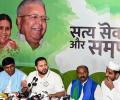
Tejashwi Yadav, the INDIA bloc's CM candidate, promised to scrap the Waqf (Amendment) Act if voted to power in Bihar, criticizing the current CM and the BJP.
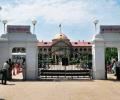
The Allahabad High Court has ruled that the Places of Worship (Special Provisions) Act, 1991, prohibits only the conversion of religious character but does not prevent the state from acquiring such properties for secular and public purposes. This observation came while dismissing a petition challenging the widening and beautification of the Dalmandi area in Varanasi for the Shri Kashi Vishwanath Dham corridor, which involved the proposed demolition of six ancient mosques.
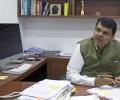
The Maharashtra Anti-Terrorism Squad (ATS) is investigating a bogus religious trust in Beed that received funds from a controversial international organisation, Chief Minister Devendra Fadnavis announced.

Congress MP Mohammad Jawed and AIMIM president Asaduddin Owaisi have challenged the validity of the Waqf (Amendment) Bill, 2025 in the Supreme Court, arguing that it violates constitutional provisions. The petitions claim the bill imposes arbitrary restrictions on Waqf properties and their management, undermining the religious autonomy of the Muslim community. They also allege that the bill discriminates against Muslims by imposing restrictions not present in the governance of other religious endowments. The bill was passed in the Rajya Sabha and Lok Sabha, with the petitioners arguing that it introduces limitations on the creation of Waqfs based on the duration of one's religious practice, mandates inclusion of non-Muslim members in Waqf administrative bodies, and shifts key administrative functions to government officials, thereby diluting the autonomy of Waqf management.

West Bengal Chief Minister Mamata Banerjee has urged voters to 'take revenge' for the deletion of names from electoral rolls, alleging the BJP is behind the changes. She also addressed concerns about EVM tampering and the deployment of officers to other states.

The specter of how the Munambam issue was exploited during the November by-elections is proof of the price Kerala is paying for its emergent politics. Controversies become the stuff of slow-burn and brinkmanship. The former promises mileage; the latter searches for an advantage, notes Shyam G Menon.

West Bengal Chief Minister Mamata Banerjee has urged voters to cast their ballots in the upcoming assembly polls as a form of 'revenge' for the deletion of names from electoral rolls, alleging foul play and urging vigilance during the election process.

In FY24, the net income generated from Waqf properties fell to about Rs 1.26 crore from Rs 150 crore in FY20.

The situation in Muslim-dominated Murshidabad district of West Bengal, which was marred by incidents of violence following protests over the Waqf (Amendment) Act, was calm and peaceful on Wednesday with no reports of any untoward incident. Prohibitory orders were clamped in and around Raghunathganj and Suti police station areas and large police force deployed in all sensitive areas of the district, especially in and around Jangipur town, where a large number of people had assembled on Tuesday afternoon, demanding the withdrawal of the legislation. Internet connectivity remained suspended within the areas under the Jangipur sub-division to prevent the spread of any disinformation. Protestors, who had gathered in large numbers on the NH-12 in the Jangipur area to protest against the Waqf Bill, hurled stones at the police who were deployed in the area, on Tuesday afternoon. A couple of vehicles belonging to the police were allegedly torched during the protest and police had to resort to lathi-charge and use tear gas shells to bring the situation under control. A few policemen were injured in the stone pelting. Police have also detained a few people in connection with the incident. West Bengal Governor C V Ananda Bose condemned the incident and said attempts to disturb the law and order situation in the state "should be put down with an iron hand". The opposition BJP alleged that the law and order situation in the state was "crumbling" under Chief Minister Mamata Banerjee, who was busy with "minority appeasement". The Waqf (Amendment) Bill was passed by the Lok Sabha on Thursday, and by the Rajya Sabha in the early hours of Friday after marathon debates in both Houses of Parliament. The Act aims to streamline the management of Waqf properties (assets permanently donated by Muslims for religious or charitable purposes) with provisions to safeguard heritage sites and promote social welfare. It also seeks to improve governance by enhancing transparency in property management, streamlining coordination between Waqf boards and local authorities and protecting stakeholders' rights.

Opposition MPs, some of whom have given their dissent, slammed the exercise as undemocratic, claiming that they were given little time to study the final report and frame their dissent notes.
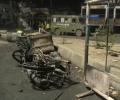
Protests against the Waqf Act turned violent in parts of West Bengal on Friday, with demonstrators setting ablaze vehicles, disrupting traffic and rail movement, and injuring several policemen. The unrest erupted in Suti, Murshidabad district, where protesters defied prohibitory orders, hurled stones at security personnel, and torched police vans and public buses during processions. Police responded with lathi charges and tear gas, while some officers were forced to seek refuge in a nearby mosque. Similar protests were held in Malda and Kolkata, prompting Governor C V Ananda Bose to direct the state government to take swift action against those responsible. The governor also contacted Union Home Minister Amit Shah and held discussions with Chief Minister Mamata Banerjee. The Waqf (Amendment) Bill, which was recently passed by both houses of Parliament, aims to improve the management of Waqf properties, safeguarding heritage sites and promoting social welfare.

Protests against the Waqf (Amendment) Act turned violent in Cachar district of Assam on Sunday, with protesters throwing stones at police and the police using batons to disperse the crowd. The incident occurred in Berenga area of Silchar town where around 300-400 people protested without permission. The Cachar district administration imposed prohibitory measures across the district under Section 163 of the Bharatiya Nagarik Suraksha Sanhita (BNSS) to prevent further unrest. The order prohibits gatherings of five or more people without permission, carrying weapons, organizing protests, and traffic disruptions.

Protesters in West Bengal's Murshidabad district set fire to police vehicles and hurled stones during a demonstration against the Waqf (Amendment) Act. The incident occurred on Tuesday afternoon in the Jangipur area, where a large crowd had gathered demanding the withdrawal of the legislation. Police responded with lathi charges and tear gas to control the situation. Several people were detained and police personnel were injured in the stone-pelting. The West Bengal Police has said the situation is under control and strict action will be taken against those who resorted to violence.

The parliamentary committee scrutinising the Waqf bill is set to propose that existing 'Waqf by user' properties will remain so if not in dispute or are government facilities but they must be registered before the new law takes effect, providing little relief to Waqf bodies in their unverified title claims.
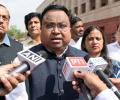
Senior leaders of the Biju Janata Dal (BJD) in India are calling for action against Rajya Sabha MP and national spokesperson Sasmit Patra for allegedly creating confusion among lawmakers regarding the Waqf (Amendment) Bill. The controversy arose after Patra, despite the party's announced opposition to the Bill, revealed he had voted in favor of it and stated that MPs could vote according to their conscience. The situation has led to accusations of a possible "deal" between the BJD and the Bharatiya Janata Party (BJP).

The Karnataka government has warned that disciplinary action will be taken against those officials who change the land mutation records and serve eviction notices to farmers under the Waqf Act.

'A genuine tribute to Dr Ambedkar does not lie in selective invocation. It lies in asking a harder question: Is the Constitution still doing its job -- restraining even assertive majorities?' asks Manoj Mohanka.

The Supreme Court has rejected a petition seeking to prevent the construction of mosques named after Mughal emperor Babur.

Both factions of the Jamiat Ulema-e-Hind (Arshad Madani and Mahmood Madani) slammed the Bill and expressed grave concerns over the proposed legislation.

A meeting of the joint committee of Parliament on the Waqf (Amendment) Bill on Friday witnessed fireworks with members vociferously opposing certain provisions of the draft legislation, leading to a brief walkout by opposition members.

Uttar Pradesh Chief Minister Yogi Adityanath has vowed to reclaim every inch of land taken under the pretext of Waqf, stating that the state government will actively investigate all "occupied" land. He also criticized the Samajwadi Party (SP) and its leaders, alleging that they failed to uphold the principles of socialist leader Dr. Ram Manohar Lohia. Adityanath praised the Maha Kumbh, highlighting its significance as a symbol of India's spiritual heritage and national unity.

'The BJP lacks a credible mass leader who matches Mamata Banerjee's popularity.' 'Given the division of votes among Opposition parties, the West Bengal government's dole-giving strategy, and the consolidation of the poor, significant sections of scheduled caste groups and Muslim minorities behind the ruling party, it will be difficult to dislodge the Trinamool from power.'

Prominent Muslim organisation Jamiat Ulema-e-Hind on Tuesday backed the Andhra Pradesh waqf board's stance describing the Ahmaddiya community as non-Muslims, claiming that this is the "unanimous position" of all Muslims.

The bench questioned the petitioner for not moving the high court and directly coming to the apex court.

A Supreme Court lawyer has written to the Attorney General seeking consent to initiate contempt proceedings against BJP MP Nishikant Dubey for his "grossly scandalous" remarks against the court. Dubey had criticized the Supreme Court and Chief Justice of India Sanjiv Khanna following the Centre's assurance that it would not implement some of the contentious provisions of the Waqf (Amendment) Act. The BJP has distanced itself from Dubey's comments, calling them his personal views.

The demolition started with the removal of the roof amid tight police security, Latif told the PTI on Monday evening.

Rajiv Gandhi, his son Rahul Gandhi, Union Minister Jyotiraditya Scindia Karan Singh, Naveen Patnaik besides celebrated authors like Amitav Ghosh and Vikram Seth studied at The Doon School.

Fourth-term Bharatiya Janata Party MP Nishikant Dubey, one of the more vocal party members in the Lok Sabha, launched a broadside against the Supreme Court on Saturday, saying Parliament and state assemblies should be closed down if the apex court has to make the laws.

Dubey launched a broadside against the Supreme Court on Saturday, saying Parliament and state assemblies should be shut if the apex court has to make laws.

Actor Vijay, founder of the Tamizhaga Vettri Kazhagam (TVK) party, has declared that his party will challenge the ruling DMK in the 2026 Tamil Nadu Assembly elections. In a general council meeting, Vijay criticized the DMK's dynasty politics, their handling of law and order, and women's safety. He also targeted the BJP-led central government over issues like the Waqf Bill, delimitation, and the three-language policy. Vijay promised his party's support to working classes, government employees, and vowed to oppose projects harmful to natural resources and agriculture. He assured 100% safety for women and strict law and order if TVK forms the government. The party passed resolutions opposing the Waqf Bill, delimitation, and the three-language policy, and also voiced support for the two-language policy, finding a permanent solution for fishermen's issues, and opposing the Parandur airport project.

The West Bengal government has assured the Calcutta High Court that the law and order situation in violence-hit Murshidabad district is under control. The court was hearing a petition by the Leader of the Opposition, Suvendu Adhikari, who alleged bomb blasts during communal riots and sought an NIA investigation. The state government claims adequate steps have been taken to quell the violence, while the Centre has requested an extension of CAPF deployment in the district. The violence erupted during protests against the Waqf (Amendment) Act in Murshidabad, displacing several families. The state government has reported that some families have returned to their homes.
The Calcutta High Court has ordered the formation of a three-member committee to identify and rehabilitate people displaced by violence during protests over the Waqf (Amendment) Act in Murshidabad district. The court also extended the deployment of Central Armed Police Force (CAPF) in the area. The committee will consist of officials from the National Human Rights Commission (NHRC), West Bengal Human Rights Commission (WBHRC), and the State Legal Services Authority (SLSA). It will be responsible for identifying displaced persons, assessing damage to properties, collecting FIR data, facilitating FIR filing, and overseeing the well-being of displaced individuals. The state government has been instructed to provide necessary infrastructure to the committee and report on its progress by May 15. The court also directed the state to formulate a rehabilitation scheme for displaced persons, including the construction of damaged houses and shops, compensation for lost livelihoods, and protection for families of those who died in the violence.
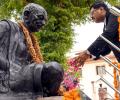
Justice Bhushan Ramkrishna Gavai, India's 52nd chief justice and its first Buddhist one, has played a key role in shaping the judicial landscape, penning about 300 verdicts, including landmark rulings on constitutional issues, liberty, and perhaps most important against the executive's 'bulldozer justice'.

The Kerala police were the most sensitised to the rights of those arrested while that of Jharkhand and Gujarat the least.
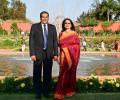
Some of his directives had the Supreme Court judges disclose their assets whereas the row over the discovery of cash from a sitting judge's official residence paved way for inquiry.

Modi can abandon the path of Hindutva only at risk to his position within his own fraternity. But if he pursues a hard line, he faces the risk of being hauled up by his coalition-partners. For the first time in a decade, Modi is not in enviable situation, observes Nilanjan Mukhopadhyay.
